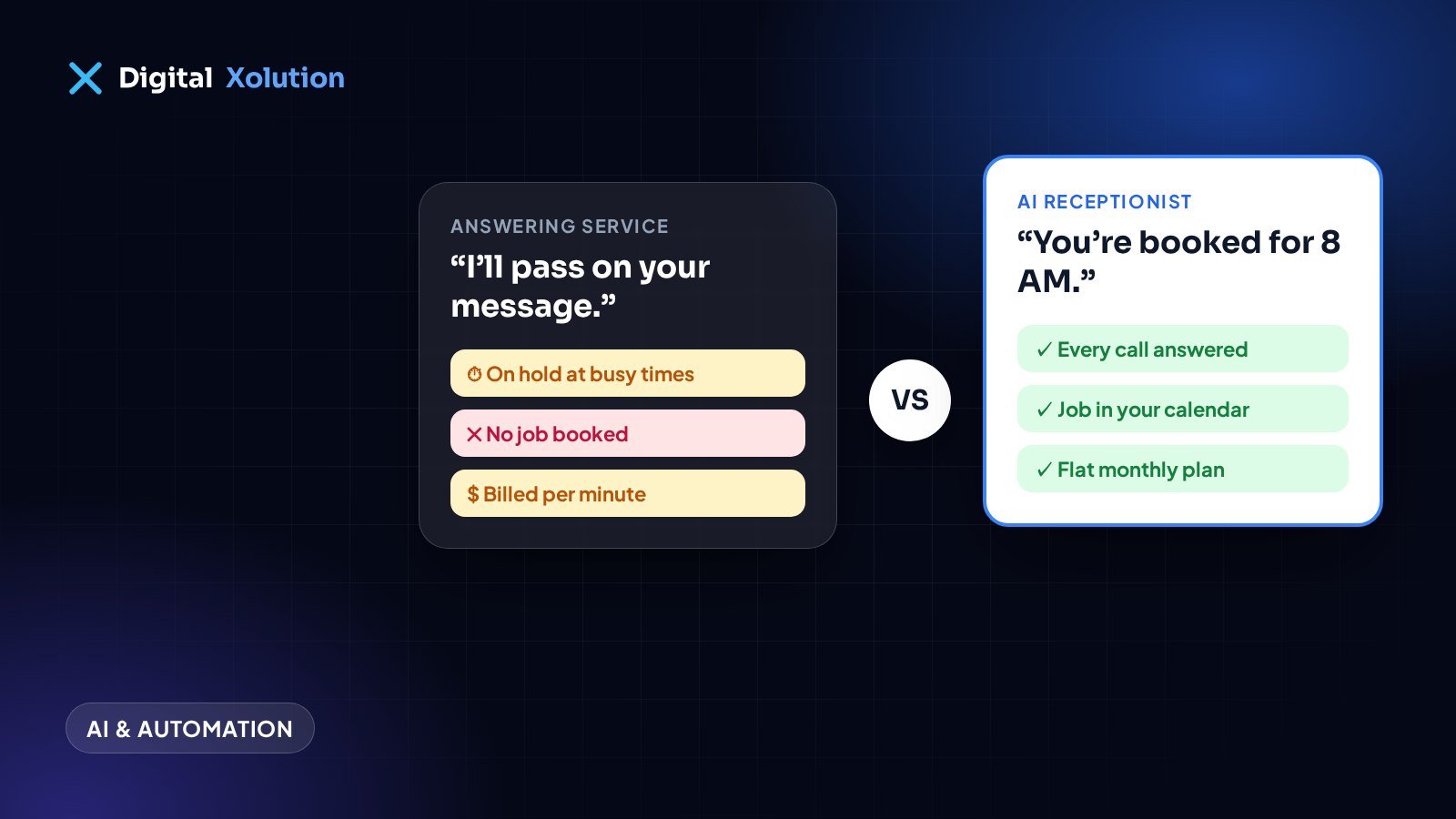
Every missed call is a customer who might phone your competitor next. Most small businesses know they need help answering the phone, but the choice usually comes down to two options: a live answering service or an AI receptionist.
Both answer calls when you can't. They work very differently, though, and the right choice depends on your call volume, your budget and what you need to happen on each call. This guide compares them side by side so you can decide in a few minutes.
The short answer
- Choose an AI receptionist if you want every call answered instantly, jobs booked straight into your calendar, and a predictable monthly cost, even when call volume spikes.
- Choose a live answering service if your calls are emotionally sensitive or highly complex, and you mainly need a polite person to take a message.
- Many businesses use both: AI handles routine calls and bookings, and urgent or unusual calls are transferred to a person.
What a live answering service does
A live answering service is a call centre that answers your phone using your business name. When a customer calls, an agent picks up, follows a script you agreed, takes a message and passes it to you by text or email.
Where it works well
- Callers speak to a real person, which some customers prefer.
- Agents can handle unusual situations a script doesn't cover.
- It's a familiar setup that's been used for decades.
Where it falls short
- It usually takes messages instead of booking jobs. You still have to call people back, and some won't wait.
- Costs grow with your calls. Most services charge per minute or per call, so a busy month means a bigger bill.
- Hold times can happen when everyone calls at once, for example after a storm or on a Monday morning.
- Agents answer for many businesses, so they rarely know your services, prices or service area in detail.
What an AI receptionist does
An AI receptionist is software that answers your phone with a natural-sounding voice and holds a real conversation. It's set up with your business information: your services, service area, opening hours, common questions and how you want calls handled.
When someone calls, it can:
- Answer immediately, at any hour, with no hold music.
- Ask the right questions: what the job is, where it is and how urgent it is.
- Book the appointment directly into your calendar or field-service software.
- Send you a summary by text or email, with the caller's details and what they need.
- Transfer urgent calls to you or a team member, based on rules you set.
Where it works well
- No missed calls, even when ten people ring at once.
- It books jobs, not just messages, so the customer is committed before they hang up.
- The cost is predictable, usually a flat monthly plan rather than per-minute billing.
- It knows your business, because it's trained on your own information.
Where it falls short
- Some callers will notice it's an AI. A good setup says so openly and offers a person when needed.
- It needs a proper setup: your services, rules and calendar have to be connected correctly.
- Very emotional or unusual calls are better handed to a human, which is why transfer rules matter.
Side-by-side comparison
| Live answering service | AI receptionist | |
|---|---|---|
| Answers every call instantly | Not always, hold times happen | Yes, many calls at once |
| Available 24/7 | Often, at extra cost | Yes |
| Books appointments | Usually takes a message | Books into your calendar |
| Knows your business | Follows a general script | Trained on your services and area |
| Pricing | Per minute or per call | Usually a flat monthly plan |
| Busy periods (storms, Mondays) | Costs and waits go up | Handles the spike |
| Call summaries | Message by text or email | Summary, details and recording |
| Human touch | Yes | Hands off to a person when needed |
Which one is right for you?
An AI receptionist is usually the better fit if:
- You run a trade or home service business (roofing, plumbing, HVAC, electrical) and miss calls while you're on a job.
- Your calls are mostly routine: quote requests, bookings, opening hours, service areas.
- Your call volume swings, for example in storm season or summer.
- You want customers booked, not just noted down.
A live answering service may suit you better if:
- Most of your calls need empathy or judgement, such as some medical or legal intake.
- You get few calls and only need messages taken.
Not sure? Start with a hybrid. Let the AI answer, qualify and book routine calls, and transfer anything urgent or sensitive to a person. You keep the human touch where it matters and stop losing the calls that slip through today.
Questions to ask before you choose
Whatever you pick, ask these before you sign up:
- Does it book appointments, or only take messages?
- How does it handle emergencies? Can urgent calls be sent straight to your phone?
- What does a busy month cost? Ask for the price at double your normal call volume.
- Can it connect to my calendar or job software?
- Will I get a summary of every call?
- Who sets it up and keeps it up to date when your services or prices change?
The bottom line
A live answering service gives you a person to take messages. An AI receptionist gives you a system that answers every call, books the job and tells you about it. For most busy small businesses, and especially contractors, the AI receptionist wins on speed, booked jobs and predictable cost, with a person available for the calls that need one.
Want to see how it would work for your business? We set up AI voice receptionists trained on your services, connected to your calendar and with your own transfer rules. Start with a free audit and we'll show you how many calls you could be missing and what we'd set up to catch them.