Most software ideas don't fail because the code is bad. They fail because months go into building features nobody asked for, and the product reaches real users too late to learn what they actually wanted.
A minimum viable product, or MVP, fixes that. It's the smallest version of your product that real people can use to solve a real problem, so you can learn from them before you spend more. Here's how to plan one.
1. Write down the one problem
Start with a single sentence: "[Who] struggles to [do what], so they [what it costs them]."
For example: "Small roofing contractors struggle to find out which neighborhoods were just hit by a storm, so they arrive after their competitors."
If you can't write that sentence clearly, you're not ready to build. If you've written five of them, pick one. Your MVP solves that problem, and nothing else yet.
2. Talk to the people who have it
Before any design or code, speak to ten people who have the problem. Ask how they deal with it today, what that costs them, and what they've already tried. Don't pitch your idea. Listen.
You're looking for two things: proof that the problem hurts enough to pay to fix, and the exact words people use to describe it. Those words become your homepage later.
3. Map the one journey that matters
Write the steps a user takes from "I have this problem" to "it's solved". For the roofing example:
- A storm alert comes in.
- The contractor sees which of their service areas were hit.
- They see the homes most likely to need help.
- They contact the owner.
That journey is your MVP. Every feature either supports one of those steps or waits.
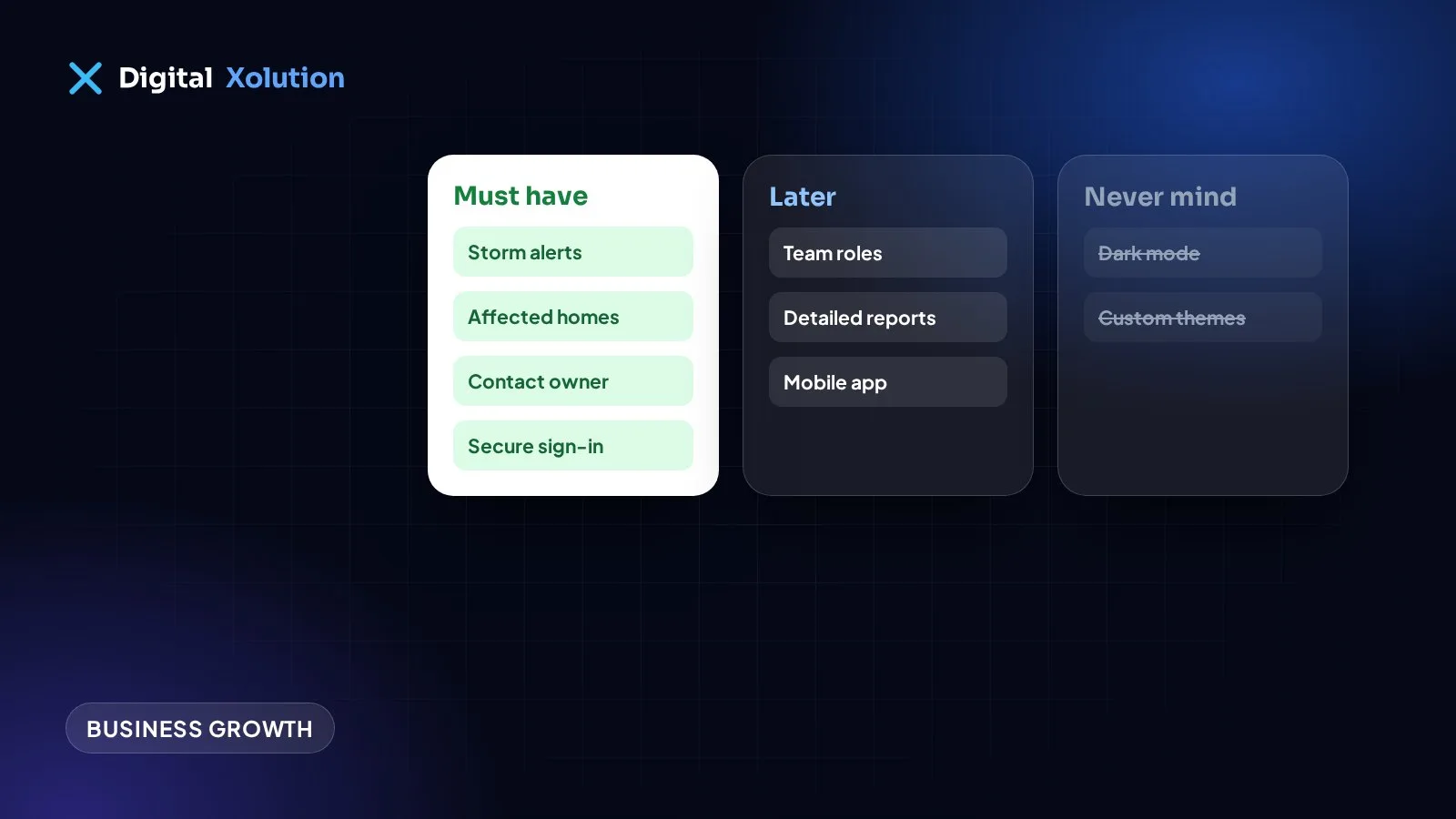
4. Sort features into three lists
Write down every feature you can think of, then sort each into:
- Must have: the journey doesn't work without it.
- Later: useful, but people can manage without it at first.
- Never mind: sounded good, but doesn't help the journey.
Be strict. Common "later" items in a first version are detailed reports, team roles and permissions beyond the basics, integrations with every other tool, a mobile app alongside the web app, and admin settings for things you could change by hand.
Some things are never optional, even in an MVP: security, privacy, backups, and the payment flow if you're charging. Cutting corners there is expensive later.
5. Decide what "it worked" means
Pick a few numbers before you launch, so you know what to look for:
- How many people sign up or start a trial?
- How many complete the main journey?
- How many come back the following week?
- Will anyone pay, and how much?
If people sign up but never come back, the problem may not be painful enough, or your solution isn't solving it yet. That's useful to learn early.
6. Build it to change
An MVP should be small, not throwaway. Choose a mainstream, well-supported technology stack, keep the code tidy and tested, and avoid clever shortcuts that make change hard. You'll be changing it a lot once real users arrive.
7. Launch to a small group first
Start with the people you interviewed and a handful of early users. Watch how they use it, fix what confuses them, and add the next feature only when users keep asking for it.
Common MVP mistakes
- Building for everyone. A product for "all small businesses" ends up perfect for none.
- Waiting for it to be perfect. If you're not slightly embarrassed by version one, you probably launched too late.
- Skipping the conversations. Analytics show what people do. Only conversations tell you why.
- Copying a big competitor's feature list. They built those features over years, for customers you don't have yet.
See it in practice
Our case studies include several products we planned and built from scratch, including Roofing Radar, the storm-alert platform used in the example above.
Planning a product? See our SaaS and MVP development service and how we work with startups and SaaS founders, or get in touch to talk through your idea.