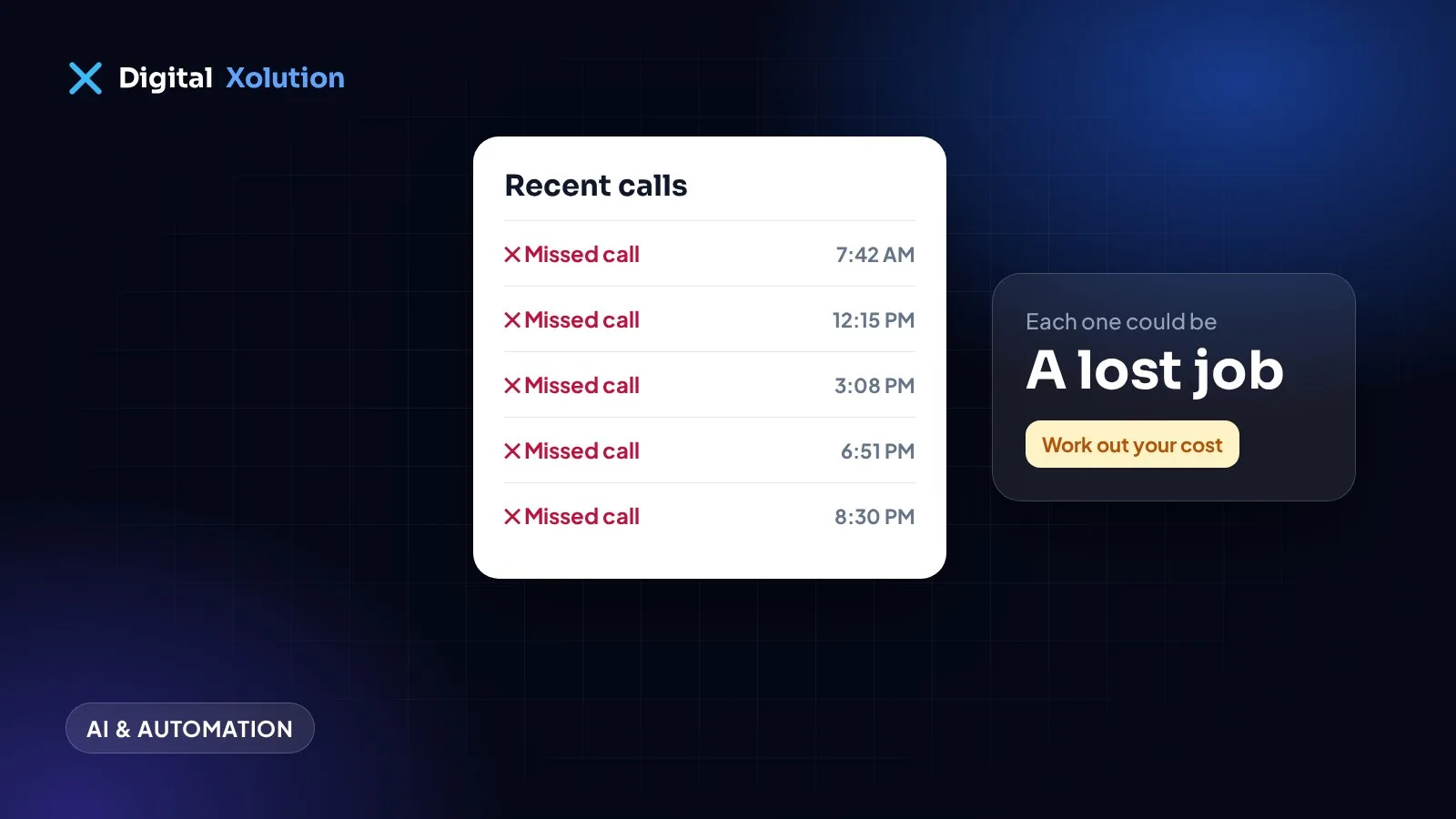
If you run a service business, your phone is probably your best sales channel, and also the one nobody measures. A missed call doesn't show up on any report. The customer just calls the next company on Google, and you never find out what the job was worth.
You don't need an industry statistic to know whether this is a problem for you. You can work it out from your own numbers in about 15 minutes.
Step 1: Count your missed calls
Most phone providers show call history in their app or online account. Pull the last 30 days and count:
- Calls that rang out or went to voicemail
- Calls that came in outside business hours
- How many of those callers left a message
Leave out spam and numbers you recognise as existing suppliers. What's left is your missed call count.
Step 2: Estimate how many were real opportunities
Not every missed call is a new job. Some are existing customers, wrong numbers or sales calls. Listen to a sample of voicemails, or call back ten of the numbers, and estimate what share were genuine new enquiries.
If you can't tell, use a cautious figure such as one in four.
Step 3: Use your own close rate and job value
You need two more numbers:
- Close rate: of the new enquiries you do speak to, how many become paying jobs?
- Average job value: what is a typical job worth to you?
Step 4: Do the sum
Missed calls × share that were real enquiries × close rate × average job value = revenue at risk each month
Here's an example with made-up numbers. Replace them with yours:
- 60 missed calls a month
- 1 in 4 are real enquiries = 15
- You close 1 in 3 = 5 jobs
- Average job is $400 = $2,000 a month
Treat your answer as an estimate. Some of those people would have called back. But even half the figure is usually more than the cost of fixing the problem.
Look at when the calls are missed
The pattern matters as much as the total, because it points to the fix:
- During working hours: you and your team are on jobs. Calls are coming in when nobody can pick up.
- Evenings and weekends: this is often when homeowners finally have time to deal with a problem.
- Lunchtime or one busy period: a small change in who covers the phone may be enough.
- Calls on one line: a number on an old ad or listing may be going somewhere nobody checks.
Your options, from cheapest to most capable
1. A better voicemail and fast callbacks. Say when you'll call back, then do it. It's free, but many callers won't leave a message, and speed depends on how busy you are.
2. A missed-call text. An automatic text goes out when a call is missed: "Sorry we missed you. What do you need help with?" It's cheap and it keeps the conversation alive. Check the texting rules and registration requirements with your phone provider first.
3. A person answering. A staff member or answering service can handle judgement calls well. The trade-offs are cost, coverage hours and how much they know about your business.
4. An AI receptionist. It answers every call at any hour, asks your questions, and can book the job or send you a summary. It should tell callers it's an AI and hand off to a human when needed. We compared the options in AI receptionist vs answering service.
Measure it after you change something
Whichever you choose, repeat the same count 30 days later. Compare missed calls, callbacks made and jobs booked. If the numbers don't move, change the approach rather than paying for something that isn't working.
Want help reading your numbers? Tell us what your phones look like today and we'll say honestly whether an AI receptionist makes sense for you, or whether a simpler fix will do. You can also request a free audit of your website and how easy you are to contact.